
Applications
Relocatable solar carports: monetise a site over 5 years, not 25
A conventional solar carport ties a site up for 20 to 30 years. A structure designed to be folded and redeployed opens up car parks without that horizon: short concessions, land awaiting development, sites in transition.
- A solar carport is usually planned for 20 to 30 years, because its structure and foundations are made to stay on one site.
- A structure designed to be dismantled without being destroyed can be reinstalled elsewhere: the car park no longer needs a 25-year horizon to generate power.
- Short concessions, land awaiting development, limited leases and sites in transition become candidates.
- The Suun Light superstructure is designed to arrive folded, deploy, lock, then be folded and redeployed, subject to a study of the new site. Foundations remain site-specific.
Why does a solar carport tie up a site for 25 years?
On most projects, the carport is designed for one location. The frame is drawn for that car park, assembled piece by piece on site and fixed to foundations sized for that ground. Taking it down often means cutting it up: it has no value elsewhere.
The economics follow. Investment in structure, foundations and civil works is paid back over the life of the solar modules, hence occupancy contracts of 20 to 30 years (third-party financing, what drives the cost). An owner who cannot commit to that horizon often drops the project, even when the car park falls under France’s APER law.
The principle: separate what stays from what travels
A demountable carport splits its parts into two families. What belongs to the site: foundations, buried networks, grid connection. What can travel: supports, the load-bearing structure and the solar modules, provided they were designed to be dismantled, transported and reassembled without loss.
That is the difference between a structure that “can be taken down”, like any structure, and a relocatable one: the latter keeps its use value from one site to the next. The carport becomes mobile equipment rather than a permanent fixture.
Which sites?
- Concessions and public service contracts: service areas, airport or station car parks whose contract is shorter than a conventional carport’s life (concessions and mobility).
- Land awaiting development: a car park earmarked for a property scheme in five or ten years can generate power in the meantime.
- Limited leases: a tenant of a logistics or industrial site who wants to produce and use its own electricity without committing the landlord beyond the lease (self-consumption).
- Sites in transition: car parks due to be reorganised, greened or reduced, where the canopy footprint must be able to change (rainwater and greening).
- Multi-site portfolios: property companies and networks that want to reallocate equipment as their assets evolve (asset owners).
How does a SUUN relocatable carport work?
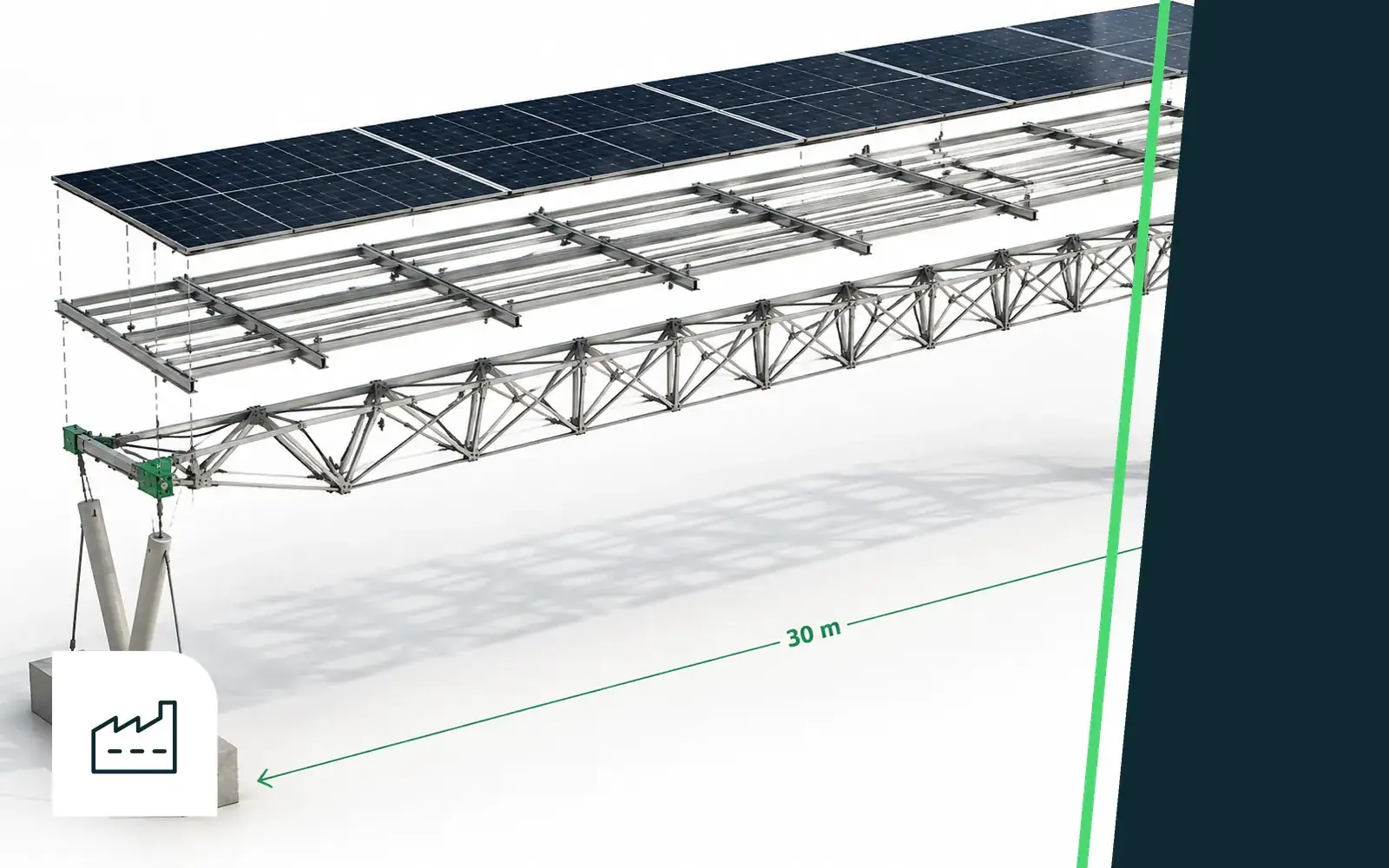
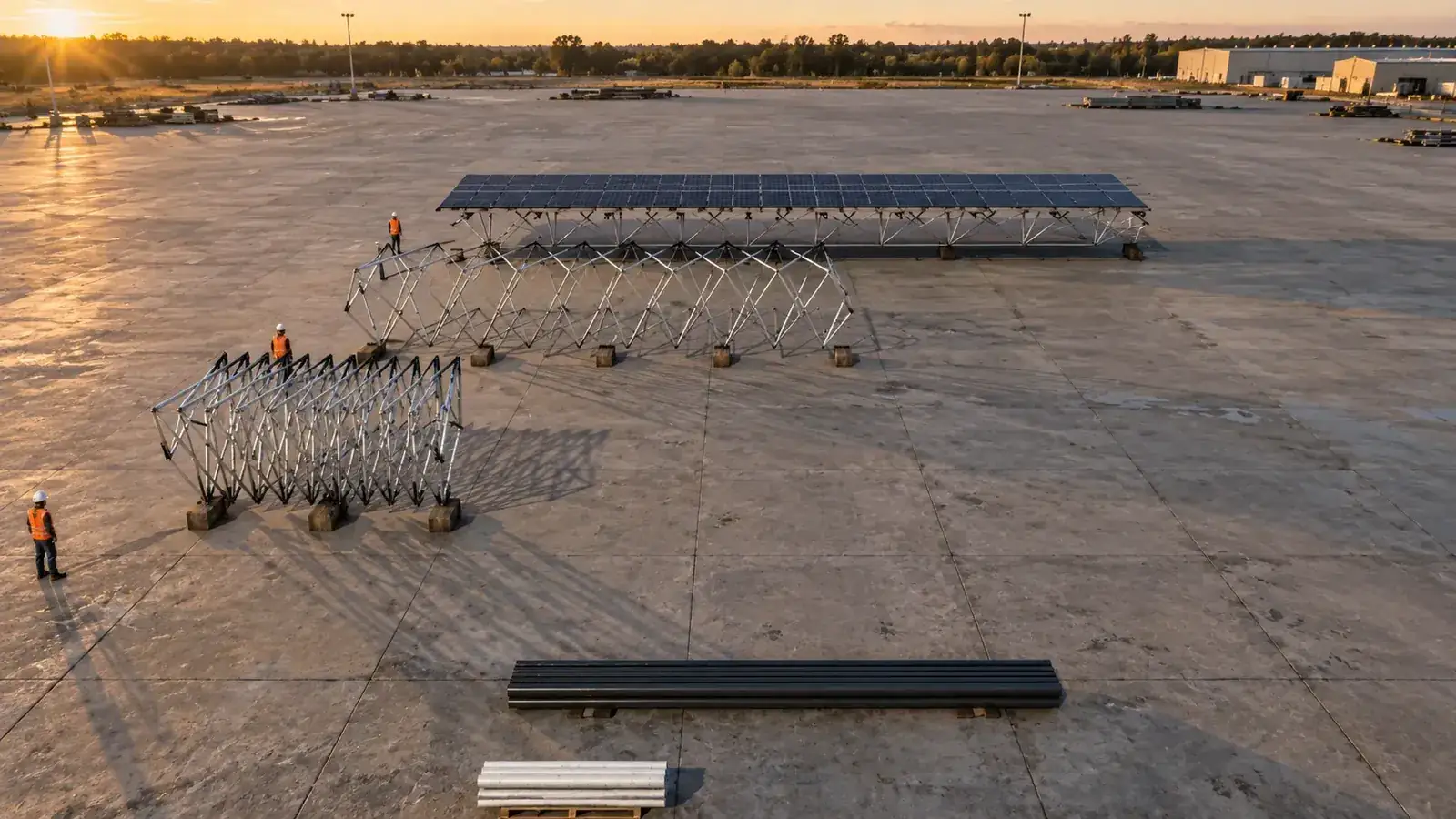
The ARKLOCK superstructure is a truss pre-assembled in the factory. It leaves the factory folded and compact, unfolds on the ground on site, is lifted onto the V-shaped UHPFRC pillars, locked and tensioned. Solar modules are then fitted on rails compatible with market modules (the Suun Light system).
Dismantling follows the reverse sequence: modules removed, tension released, unlocking, folding and transport. The UHPFRC pillars, with no coating to maintain, are designed to last several decades (UHPFRC). Foundations stay point-based, one per support, which limits what remains to be dealt with on the original site (foundations).
Each redeployment requires a study of the new site: snow and wind loads, ground, layout, clear height (snow and wind). The module stays the same; its checks change.
Conventional or relocatable carport
| Conventional carport | SUUN relocatable carport | |
|---|---|---|
| Typical horizon | 20 to 30 years on a single site | Duration matched to the site, then possible redeployment |
| Assembly | Frame assembled piece by piece on site | Superstructure pre-assembled in the factory, unfolded and locked on site |
| Dismantling | Often by cutting, limited reuse | Reverse of assembly, designed in from the start |
| Foundations | One per column, many | One per support, few, site-specific |
| End of contract | Dismantling and reinstatement, or extension | Redeployment, sale, extension or reinstatement |
| Maturity | Proven solution | First projects designed, ARKLOCK prototype in preparation |
Comparison in principle. Dismantling and redeployment terms are defined project by project, from the design stage.
What changes for the project economics
Over a short horizon, the question is no longer just “what does the carport earn on this site?” but “what is the structure still worth at the end?”. A reusable structure keeps a residual value: it can move to another car park owned by the same company, be sold, or serve a new contract.
Not everything travels, though. Foundations, networks, grid connection and permits stay attached to the original site and are paid back over its occupancy period. The model therefore makes sense when those items are kept under control, which long spans help by reducing the number of supports. The SUUN simulator gives a first estimate of output and financing options; the site study prices the short-horizon scenario.
Points to watch
- The contract: duration, dismantling terms, reinstatement, ownership of the structure and what happens to the modules at the end.
- Grid connection: its costs and lead times are site-specific and do not transfer (grid connection).
- Permits: each new location goes through its own planning procedure (planning in France).
- APER compliance: in France, the owner in principle remains responsible for the car park’s compliance, including when equipment moves to another site.
- Maturity: SUUN’s first four projects are designed and the ARKLOCK prototype is in preparation; dismantling and redeployment performance will be validated on site.
Frequently asked questions
Can a solar carport be installed for just 5 years?
Yes, if the structure is designed to be dismantled and reused, and if the contract organises the end of the period. Foundations, grid connection and permits remain site-specific and must be paid back over the occupancy period.
Are the foundations reusable?
No: they are sized for each site’s ground. Long spans reduce their number, which limits what remains to be dealt with at the end.
What happens to the car park after dismantling?
Supports are removed and foundations handled as the contract provides. The rest of the asphalt was never touched, since foundations are point-based.
Is a new study needed for the new site?
Yes. Snow and wind loads, ground, layout and clear height are checked for each site. The module stays the same; its checks and, if needed, its options change.
Is a demountable carport less robust?
No. It is designed to the same Eurocodes as any carport, for the loads of the site where it stands. The ARKLOCK locking is part of the structural system.
General information, up to date at the date shown. Each project’s design and regulatory compliance must be validated by competent professionals.